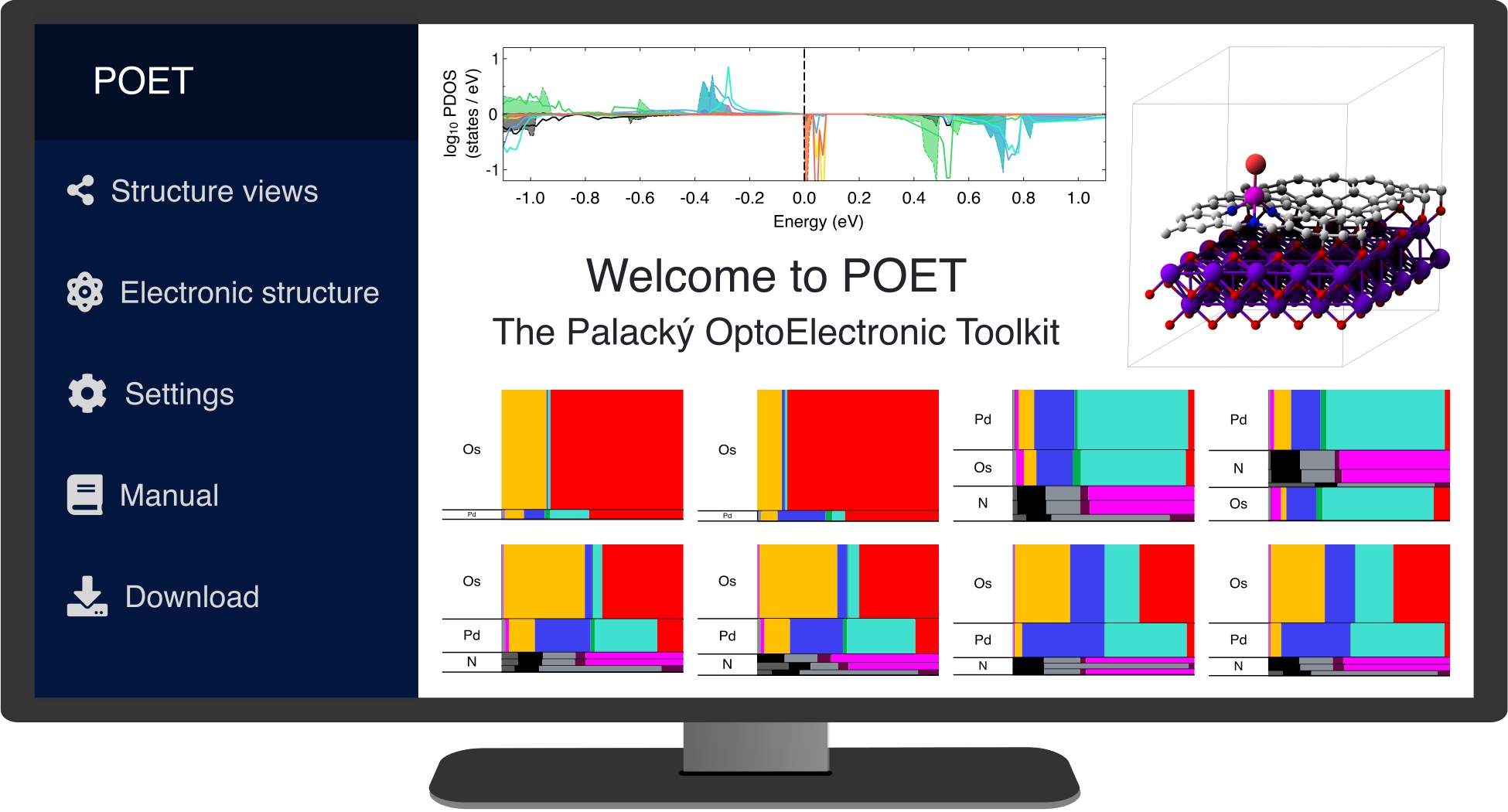



How can complex quantum-mechanical calculations reveal which atoms and orbitals govern the magnetic and optical properties of a material? A new open-access software suite, POET, the Palacký OptoElectronic Toolkit, developed as part of Jan Navrátil’s doctoral research at CATRIN, Palacký University Olomouc, can help answer this question.
The software allows researchers to trace calculated material properties back to individual atoms and orbitals, helping them interpret microscopic mechanisms that would otherwise remain difficult to identify in raw computational output. These insights can support the development of functional materials for applications including energy-efficient information storage and processing at the atomic scale.
The software and its applications are presented in a recently published article in The Journal of Physical Chemistry A. “Its free release for non-commercial research will enable the wider community to apply these analysis methods to other materials and electronic-structure problems,” added Piotr Błoński, Jan Navrátil’s doctoral supervisor and co-author of the paper.
“Electronic-structure calculations generate large amounts of data, but extracting a clear physical picture from them is often challenging. POET converts these data into intuitive visual representations. By mapping changes in electronic structure onto individual atomic and orbital contributions, the toolkit helps researchers understand why a material exhibits a particular property. It can, for example, identify the specific atoms and orbitals responsible for magnetic anisotropy, a property that determines the stability and preferred orientation of magnetic moments. The toolkit can also be used to analyse optical excitations and other electronic-structure phenomena,” said Navrátil.
POET is freely available for non-commercial use through a web application at https://poet.run. “Its free release for non-commercial research will enable the wider community to apply these analysis methods to other materials and electronic-structure problems,” added Błoński.